

When documentaries become a driver for action the ai doc or how i became an apocaloptimist screening at the ai for good summit

Listen to this article
Read by Anchor
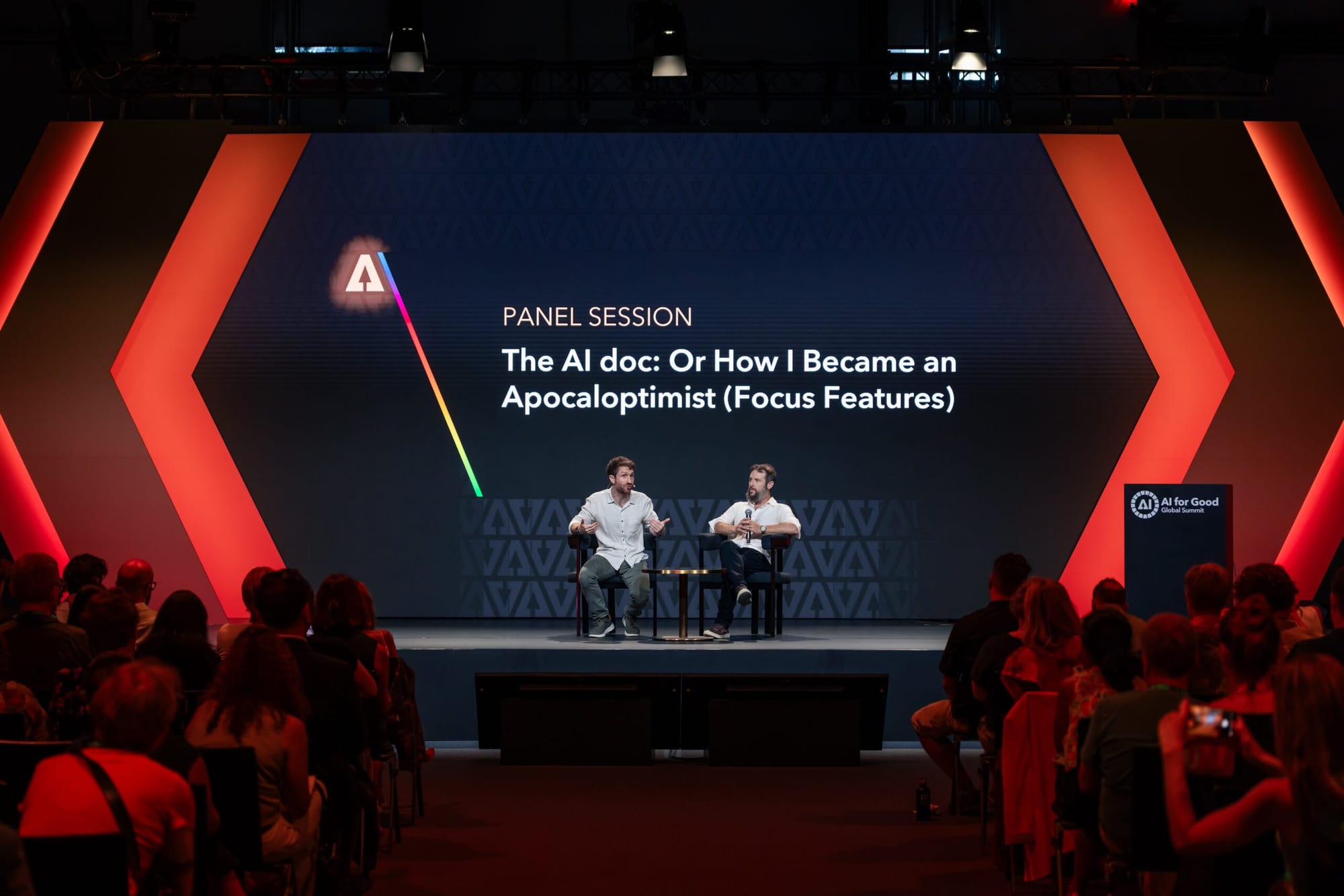
In a hall filled with technologists, policymakers and citizens, the presentation was not just a film to watch and then set aside. The new documentary "The AI Doc: Or How I Became an Apocaloptimist," shown at the AI for Good Summit 2026, placed the audience before a single question that was repeated in different forms throughout the Q&A session: what does an audience of this kind do after seeing what they have seen?
The film is co-directed by Daniel Kon and Daniel Shainert (the "Everything Everywhere All at Once" team) and the crew that produced "Nafalni." They do not present a techno-horror story, but a document that opens space for collective confrontation. Tristan Harris and Aza Raskin, co-founders of the Center for Human-Centred Technology, moderated the dialogue after the screening and repeatedly referred to a single historical reference: the 1983 American TV movie "The Day After," which depicted the consequences of a nuclear war between the United States and the Soviet Union. It was watched by Ronald Reagan, and it was recorded that it contributed to his commitment to arms reduction and led to the Reykjavik talks of 1986. The fortieth anniversary of those talks is approaching, and, as Harris said, the aim of the new documentary is to open a similar space for collective work on artificial intelligence at a moment when the prevailing fear in the sector is falling behind competitors rather than the direction of technology for humanity as a whole.
The Spell of DeterminismThis expression was repeated by the filmmakers. When people believe that a technology is on a fixed trajectory, they act as if nothing can be done, and others see that and do the same thing. "It’s not that we can stop technological progress," Harris said, "but the future we will end up in with artificial intelligence is still in our hands." Raskin added that the feeling of powerlessness cuts across official authority positions, and recounted a recent Q&An in which a coach for a chief executive of a major AI company said the executive asked: what can one person do? The suggested answer was what they called "reach up and out." Individual agency, Raskin said, rarely suffices in the field in which anyone works. A teacher trying to remove smartphones from a classroom will find students rallying around the ban; the solution, he said, is organization at the regional level and then scaling. The same pattern, Harris said, applies to lawyers, regulators and journalists, and to what a single executive in an AI company can achieve alone.
Fear as a Strategic QuestionA member of the audience raised a question that the filmmakers had not set aside. She said the film left her more worried about how people might respond to it than about artificial intelligence itself, and asked whether they had considered implications for viewers who conclude that the future is closing. Raskin acknowledged the tension outright. The risk that a documentary can produce, he said, lies between a human-hostile outcome and a chaotic one, and the responsibility of those involved is to offer a practicable alternative alongside the warning, not the warning alone. Harris said he prefers to speak with a small number of decision-makers, but the historical record on existential questions, including the nuclear freeze movement, indicates that collective agency was necessary rather than incidental.
On practical questions from the audience, the filmmakers gave brief answers. Regarding the risk of deep-fake manipulation in family communication, they advised families to agree on code words to verify identity and pointed to a case they knew from California in which a synthetic voice was used in a kidnapping-related fraud attempt. As for what parents and teachers can do, they said tools exist within specialized organizations, and that youth participation is one of the responses they see as insufficiently leveraged.
What Moved BeforeIn conclusion, Harris and Raskin referred to their earlier documentary "The Social Dilemma" (2020) as evidence that public discourse can shift on similar questions. Harris said several jurisdictions, starting with Australia and followed by Denmark, Spain, the United Kingdom, Malaysia and India, have since introduced protections that restrict children’s access to social media, now covering roughly 10 % of the world’s population. He pointed to prosecutors who saw the previous film and have since filed lawsuits against a major social-media company for combined harms of about $1.4 trillion, and to the recent addition of artificial intelligence to the agenda of discussions among United States and Chinese leaders, which several observers had thought unlikely two months earlier. Raskin added that all these outcomes once seemed impossible. Harris revealed a note from that morning: Halla Tómasdóttir, Iceland’s president, who was on the summit’s main stage, said she intends to screen the documentary throughout her country and host citizen dialogues in response.
The full session "The AI Doc: How I Became an Apocaloptimist" is available on the AI for Good YouTube channel. The next Global AI for Good summit will be held in Geneva during the week of 21 to 25 June 2027. Early registration is now open.