

What Remained After Itqan Community’s Second Cairo Meetup

Listen to this article
Read by Anchor
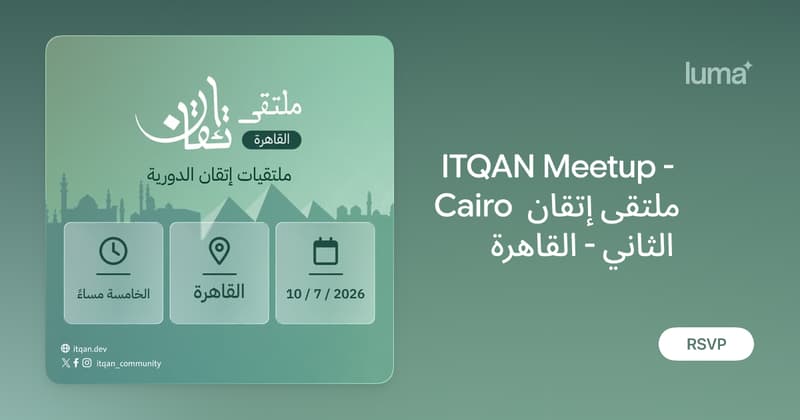
The question at Itqan Community’s second meetup in Cairo on July 10 was not about an app that attracts attention for one day. What remained after the evening was more difficult: can Quranic technology projects be built as useful tools that can be examined and maintained, and that do not stop when their founder withdraws? The answer left by material later published by Itqan Community was more practical than rhetorical.
The gathering took place in New Cairo, bringing together developers, researchers, designers and initiative leaders around Quranic technologies. Official community posts afterwards documented that the platform did more than introduce the community. It hosted presentations of existing projects and two closing talks by engineer Mohamed Tarek and engineer Hassan Al-Ansari from the technical team. The difference matters: an announced programme alone is not enough to assess the outcome, but documenting what was presented, with later recordings of some presentations, makes it possible to read what happened without filling gaps with impressions.
From an open idea to shared responsibility
Mohamed Tarek’s talk focused on the impact of contributing to open-source Quranic projects. The community presented open source as a route to transparency, auditability and continuity, not merely a software licence. Hassan Al-Ansari then presented a community-contribution experience connected to the Mushaf Emad project. The message for Arab builders is direct: a product serving sensitive, long-lived knowledge needs clear records, review by more than one person and a path that allows the next developer to continue the work.
The presentation that brings technology closer to use
Among the material the community later published was the Al-Kitab app in a presentation by Tarek Mansour. The app offers tafsir, word meanings, pronunciation and natural-language search, alongside AI-supported features for following recitation and helping with memorisation, revision and reminders. Its value is not in gathering many features into one interface. It lies in testing a stricter question: do these functions help someone return to the text, understand it and review it, or are they merely a technical layer over an unchanged experience?
Ahmed Hany presented the Mihrab Al-Quran project, which combines direct learning with licensed teachers and AI tools to correct recitation and test memorisation. The published material says the project offers learning in twelve languages, with interactive Qurans and models to explain articulation points and Tajwid rules. This establishes a useful standard for projects in the region: AI does not replace the teacher or the reference, but it may broaden access and give learners repeated practice between sessions.
Cairo is not peripheral to this path
When language, content and learning projects gather around an open infrastructure, local knowledge becomes part of the product rather than a deferred translation of a foreign product. The region therefore needs not only to adopt ready-made tools, but also to have teams that preserve data, document decisions and clearly define where automated assistance ends and human review begins.
The positive signal is that the community did not stop at event photographs or a closing announcement. It published recordings and material from the presentations. The point to watch remains absent from the available material: there are still no published figures on app use, the impact of contributions or how the accuracy of AI-supported features is evaluated. Measurement here is not an administrative luxury. Anyone seeking to improve the experience of memorisation or revision needs to know when a feature helped a user and when it confused one. Anyone seeking to expand open contribution needs to show how additions are reviewed and trust is maintained. Readers also need to distinguish reviewable documentation from general promises. That is the next step that would turn what began in the room into knowledge that can be built upon.