

Codex Security Wants to Scan 2,000 Repositories Before You Pick the First

Listen to this article
Read by Anchor
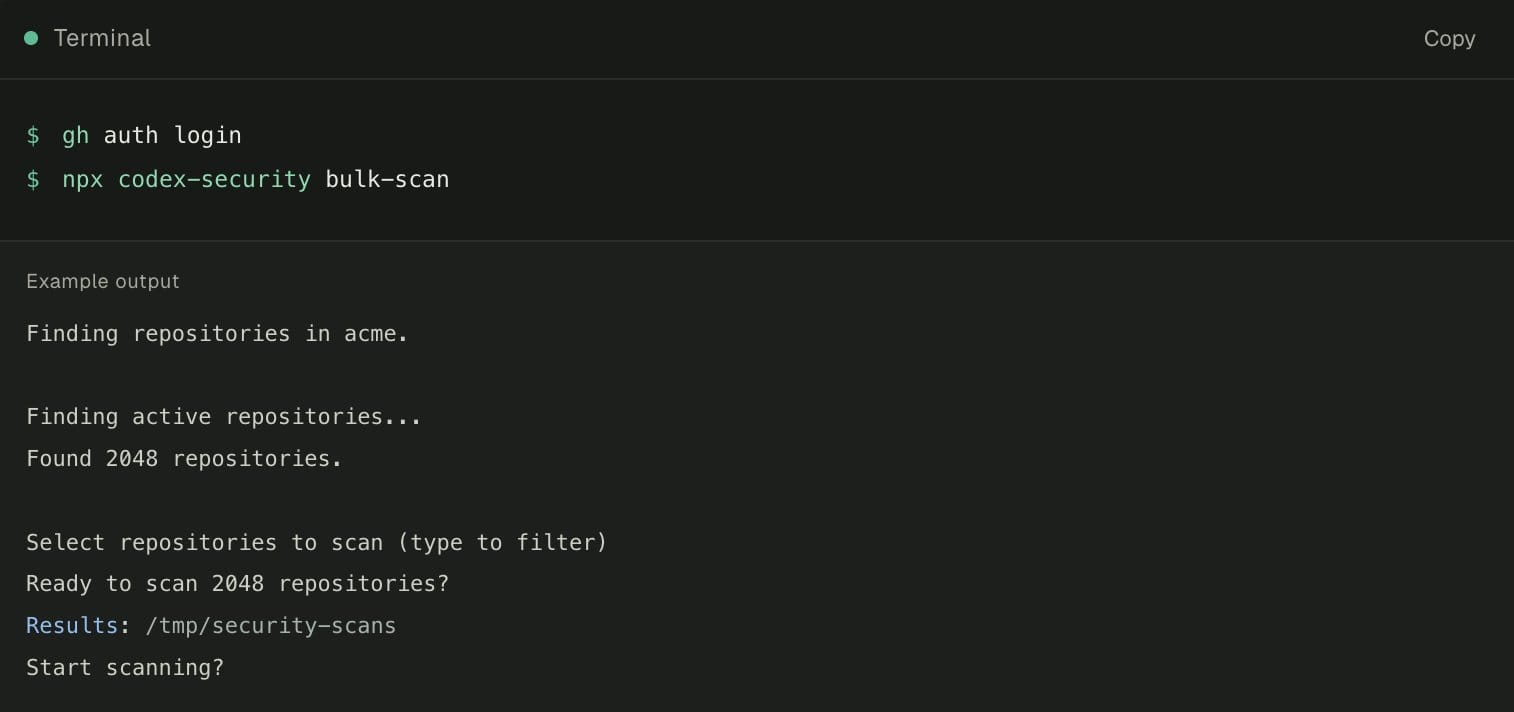
A conventional security scanner waits for you to specify the repository and the rules. OpenAI's new screenshot presents a more ambitious workflow: sign in to GitHub, then let Codex Security find active repositories and prepare a bulk scanning campaign.
In the published example, the command finds 2,048 repositories in a fictional organisation, allows them to be filtered, then starts the scan and saves the results. The command is short, but the workflow behind it turns Codex Security from an interface for scanning one project into a tool that could become part of the work of a platform team or central security function.
The scan starts with a threat model
According to OpenAI's documentation, Codex Security does not operate merely as a set of signatures looking for known strings. It reads the codebase and change history, then builds a project-specific threat model that identifies attacker entry points, trust boundaries, sensitive data and high-impact paths.
It then looks for realistic attack paths, ranks them by likelihood and impact, and tries to reproduce each potential vulnerability in an isolated environment. If verification succeeds, it proposes a small change that addresses the root cause. The change is not added to the repository automatically. It waits for human review and can be turned into a pull request.
This loop matters because the biggest problem with security analysis tools is not a shortage of alerts, but their volume and weak signal. Trying to prove exploitability before presenting a finding reduces the time a team wastes on theoretical warnings that do not apply to its environment.
A bulk campaign creates a new problem
When scanning moves from one repository to 2,000, the issue is not simply speed. Scope must be defined carefully, findings routed to their owners, vulnerability details protected and untrusted code prevented from running outside isolation. A threat model suited to a payment service is also not suitable for an interface library or infrastructure repository.
The published image points to the use of a command-line tool named codex-security alongside the GitHub CLI. However, the main help document currently focuses on connecting GitHub repositories through Codex Security and describes the product as a research preview for ChatGPT Enterprise, Edu, Business and Pro users. It is therefore more accurate to read bulk scanning as an emerging capability, not as a mature replacement for every enterprise vulnerability management platform.
The safe starting point is not every repository
OpenAI itself recommends starting with a small set of repositories and a defined group of reviewers, refining the threat model as the team learns, and testing less sensitive repositories if the organisation is new to GitHub Cloud. It also recommends reviewing remediation pull requests through the usual process and applying code review to proposed changes so that a fix does not close one vulnerability while creating a new regression.
That puts the tool in its proper place: an automated security researcher that extends a team's capacity, not a lone gatekeeper that decides, edits and deploys. The value is not that it can find 2,000 repositories in seconds, but that the team knows where to start, which finding the tool was able to verify and who owns the remediation decision.
The short terminal command is tempting. The real work begins afterwards, when the long list becomes a set of clear responsibilities instead of another inbox full of alerts.