

When an AI Agent Fails, Accountability Still Rests with a Human

Listen to this article
Read by Anchor
When a financial system fails in production, the model does not wake up to fix it. A human engineer does, and that engineer remains accountable. That point, rather than the technical presentations, was the conclusion of a full morning with fintech engineers at FinTech Hive in the Dubai International Financial Centre (DIFC) on Wednesday, July 22, 2026.
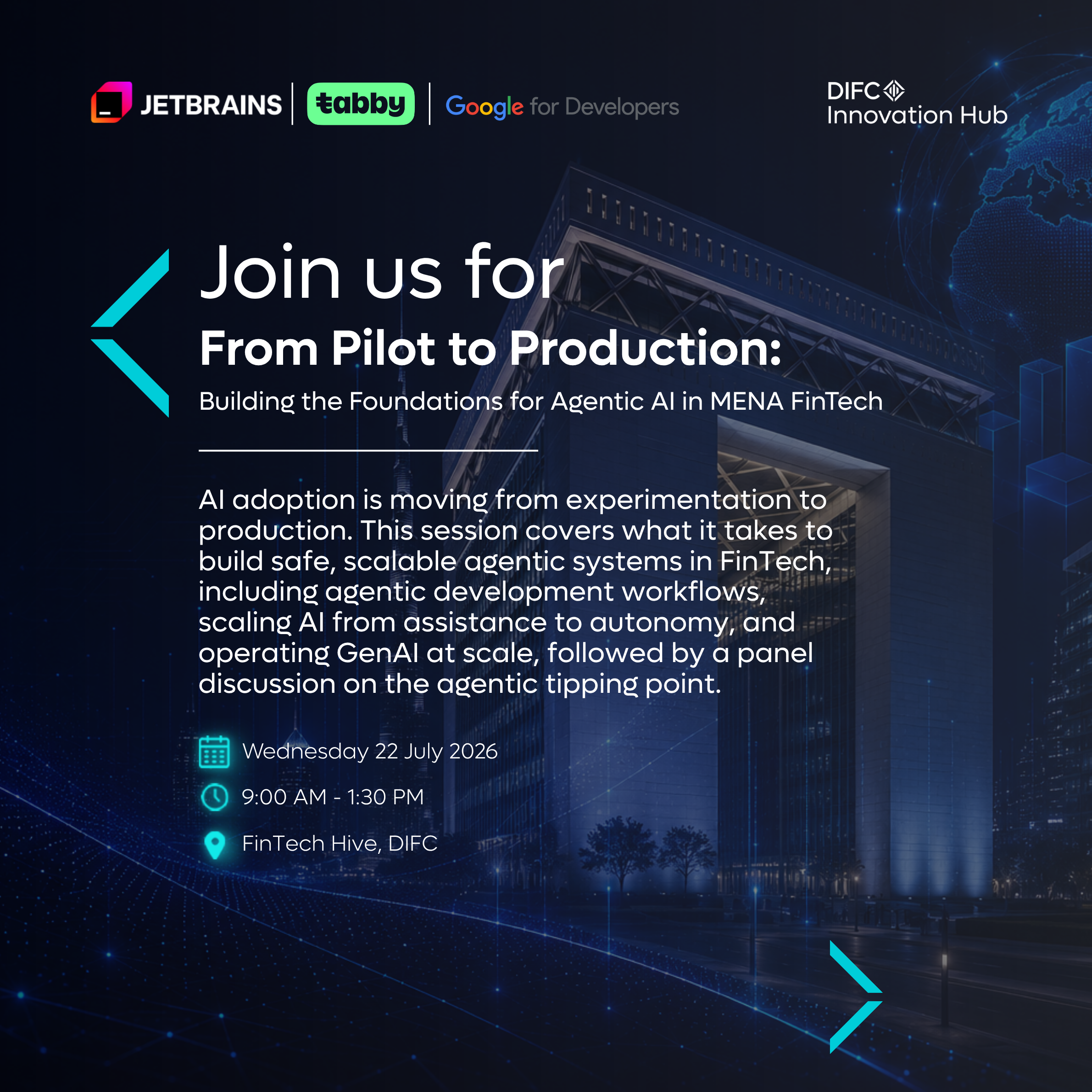
DIFC Innovation Hub organised a session titled From Pilot to Production: Building the Foundations for Agentic AI in MENA FinTech, bringing together JetBrains, Tabby and Google for Developers from 9:00 am to 1:30 pm. The title itself carried the session's verdict: the question is no longer whether fintech companies will adopt AI agents, but whether they have the engineering foundations to operate them safely and at scale.
Accountability cannot be delegated to a machine. Nadia Rinsky, Head of MENA GTM at JetBrains, said the UAE's regulatory environment favours financial innovation, but scaling AI agents runs into a simple operational reality. AI has nothing to lose, so it cannot bear the consequences when something goes wrong. When a critical system fails in production, the human developer gets the call. She added that the developer's role is shifting from writing code manually to directing, supervising and verifying fleets of agents, and that real progress lies not in generating cheap code but in controlling it.
The numbers explain the urgency. The session followed a Dubai Financial Services Authority (DFSA) survey showing that more than half of authorised firms within DIFC now use AI, up from about one third the previous year, while the use of generative AI tools nearly tripled over the same period. That is the context that makes the discussion about engineering foundations urgent rather than theoretical.
Where agents are already working. Tabby, one of the region's largest shopping and financial services apps, offered a field view of deploying agents within a live product. Denis Sakhnoc, Head of AI Agent Platform at the company, said good candidates for automation in fintech include fraud prevention, Know Your Customer (KYC) procedures, customer support and repetitive work more broadly, provided that human approval and evaluation remain in the process. The gain is operational efficiency within the limits of financial regulation, not full independence from it.
Infrastructure before the model. Majid Jamaah, Head of Cloud and DevOps at Beyond AI and a Google Developer Expert, mapped the infrastructure an organisation needs to run generative AI and agents at scale. He stressed designing for variable traffic, cost and latency, and starting with the simplest solution before scaling as real usage reveals the limits. JetBrains presented its framework for moving from scattered individual experiments to an organised team-wide capability. It argued that centralised governance, including model policy, precise cost allocation and workflow auditability, is not a constraint on the developer but the safety system that allows them to move faster.
What the session did not provide. The event should be read for what it was: a gathering organised by tool providers, with a framework that naturally serves their products. The DFSA figure also measures AI use in general, not the number of independent agentic systems actually operating in production. No such figure was published. The direction is documented, but the true scale of autonomous adoption still has no public measure.
The practical conclusion for anyone building in this sector in the region remains clear. Before asking which model is strongest, ask about the evaluation and testing process, who signs off on the code before it is merged, and whether you can audit what the agent did after it acted. Those are the foundations that turn a pilot model into a system that can be trusted with people's money.
Featured in this issue AI Gossips Agenda, Issue 9 (September 2026)