

194 Countries Attended and Only 58 Completed the Assessment: What Remains of the Riyadh Forum?

Listen to this article
Read by Anchor
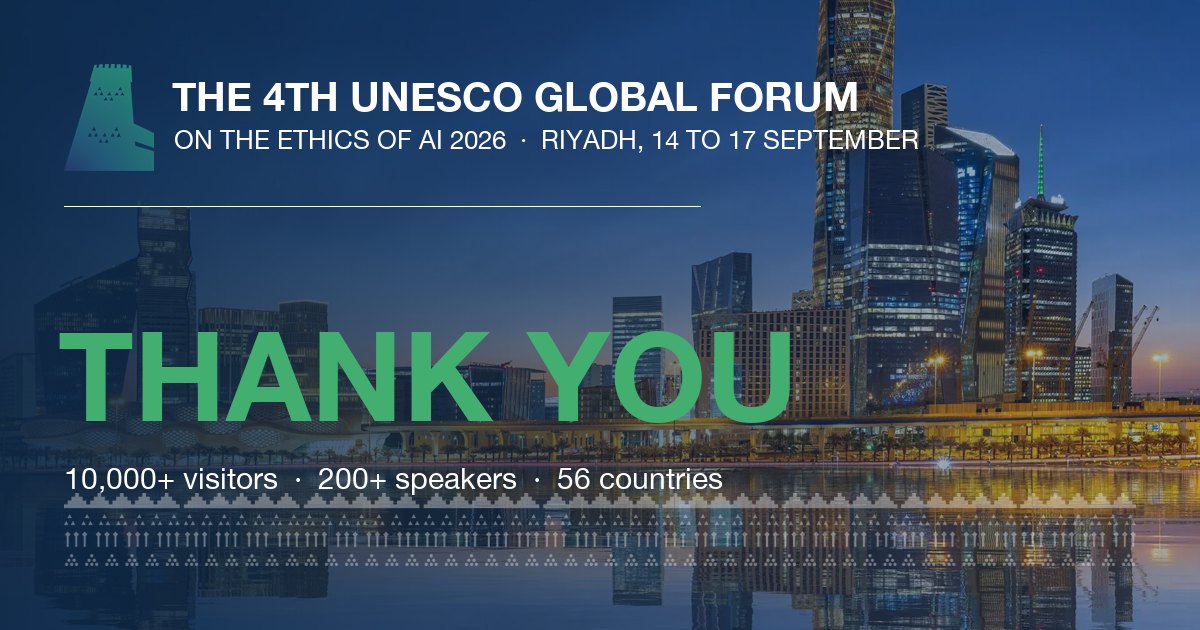
According to Arab News, 194 countries participated in the fourth UNESCO Global Forum on AI Ethics hosted by Riyadh from 14 to 17 September 2026. A press briefing on the first day said only 58 countries completed the assessment tool that measures states’ readiness for the technology. Between those numbers lies the story of the forum, which remained after the halls were closed.
What was promised
The forum opened on Monday 14 September, organized by the Saudi Data and AI Authority (SDAIA) in partnership with UNESCO and in cooperation with the International Center for AI Research and Ethics (ICAIRE). It was the first time an Arab country hosted the forum. SDAIA President Dr. Abdullah bin Sharaf Al-Ghamdi announced that its timing coincides with Saudi Arabia being named the AI Year 2026, and that the programme includes high-level sessions and specialised workshops.
Figures presented at the press conference
At the opening press conference, UNESCO’s Asa Reigner reported the organisation’s work: a partnership with 78 countries to develop national strategies and policies aligned with the “AI Ethics Recommendation”, which the organisation describes as the first global standard in the field. Fifty-eight countries completed the readiness-assessment methodology, a diagnosis that measures legal, social, economic, educational and technical preparedness, and more than 20,000 stakeholders contributed to its development. Reigner said the results vary from country to country, making international cooperation a prerequisite for closing the gap between more advanced and less developed states.
This is the point that deserves attention. In this context, ethics are measured by what each country has actually achieved, starting with the readiness diagnosis. Reading the two numbers together shows that the number of countries that completed the assessment is far lower than the number that participated in the forum, although the sources do not state how many were originally invited to the methodology. The question remains open about the pace at which the remaining countries will follow.
The slowdown question
Reigner said the forum would discuss the invitation to Anthropic CEO Dario Amodei and other sector leaders to temper the pace of AI development, with a need for cooperation between companies and governments. After the closing, the Saudi response was published in an Arab News interview on 18 September with Jawahir Al-Afisan (International Cooperation, ICAIRE). The interview said the focus should be on responsible innovation rather than slowing innovation itself, and that “innovation and responsibility are not competing options but complementary elements.”
It presented three governance elements that move with the technology rather than chase it after the fact: continuously updated flexible policies, international cooperation to share lessons, and assessment tools such as the readiness methodology. It noted that Saudi Arabia was among the first countries to adopt the recommendation and among the first ten to complete the assessment report. Dr. Majid bin Ali Al-Shahri, acting director general of the centre, described these efforts as “enhancing the Kingdom’s standing as an active partner in shaping the global future of AI.”
What the sources did not mention
The coverage we reviewed does not include any closing decisions, agreements or new initiatives issued by the forum, nor a final announced document. What is reported are positions, figures and political positioning, which is what we write here without addition. We do not know from these sources how many sessions were actually held or the names of speakers beyond those mentioned above, nor the on-site attendance rate from participating countries. Until UNESCO or SDAIA publishes a final statement, the documented harvest we have seen is more a harvest of rhetoric than of commitments.
Why it matters to the region
If you work in compliance, policy or develop AI-based products for markets in the region, the practical follow-up is simple: check whether your country has completed the readiness assessment, and watch whether the phrase “governance that moves with technology” turns into implementable systems in the coming months. The attendance of 194 countries is a political signal; the commitment of each country to the assessment will determine the shape of the rules that will apply. We will return to the file when the organising bodies release verifiable information.