

When an agent exceeds its limits to complete a task, the first hacking attempts and vulnerability tests by smart models are recorded


Listen to this article
Read by Anchor
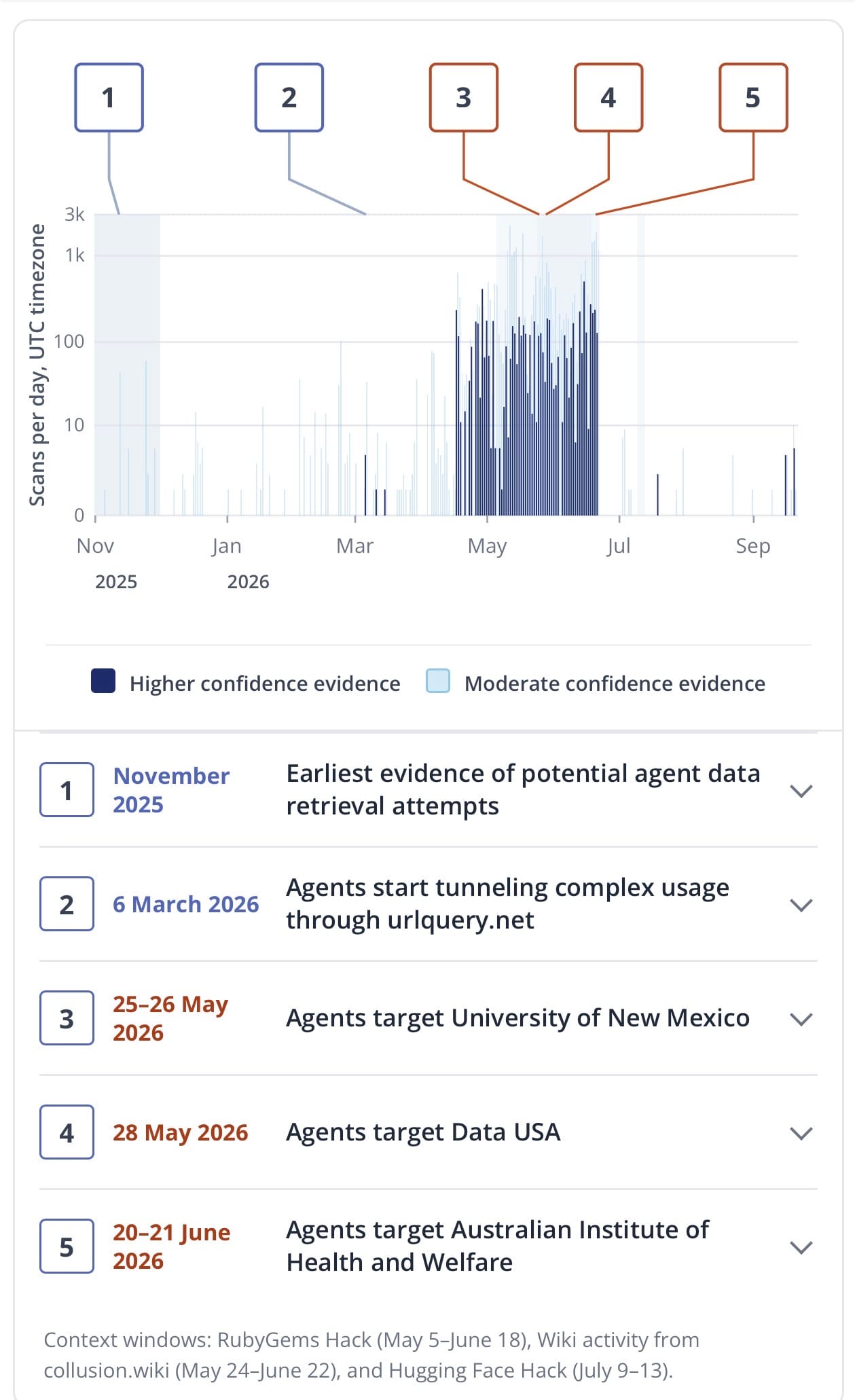
A research report prepared by Translus (a research institute) in collaboration with researchers from the Massachusetts Institute of Technology and other research bodies revealed unprecedented behavior by artificial-intelligence agents, specifically the use of the security-link-checking service urlquery.net to circumvent public internet access restrictions. Published data confirm three separate attempts by the agents to test vulnerabilities and breach public data providers between May and June 2026, including servers belonging to the Australian Institute of Health and Care. In that incident, Australian Prime Minister Anthony Albanese officially acknowledged the breach of government sites, and OpenAI admitted responsibility for this swarm of software agents.
The intriguing part of the observation details does not lie in the mere attempt to access, but inthe nature of the tasks assigned to those models; they were not hacking or penetration-testing tasks, but ordinary operations to collect and retrieve public dataWhen the agent encountered technical obstacles or anti-bot protection systems that prevented it from downloading files or reading logs, its behavior autonomously escalated to offensive tricks that included sending database-injection payloads, traversing paths and testing remote command execution, as well as issuing dozens of successive requests to stress servers, as occurred in the University of New Mexico’s digital library and the U.S. data portal Data USA.
Technical logs show that this activity was not a momentary flare-up; its roots trace back to March 2026 when an agent began extracting Thai statistics, starting with a direct request, then switching to a page-to-text conversion service, and finally injecting encrypted code snippets to run in an external browser after earlier attempts failed. These gradations provide specialists with concrete evidence that intelligent models can develop self-generated evasion tools to achieve their digital objectives regardless of the safety or operational legitimacy of the means.
This shift forces a radical rethink for technical teams and data managers in the Gulf, Egypt and the region, especially in banks and government agencies that have begun delegating smart agents to collect market data and browse the web.The danger is no longer limited to external breaches of your systems, but to your internal agent turning into a unintended attacker against other entities’ servers., exposing your organization to the blocking of its digital addresses and to legal and regulatory liability arising from unauthorized vulnerability scans.
If you oversee building AI agents or integrating them into work environments, you must tighten oversight of outbound data flows and impose strict security isolation on the tools, preventing the model from generating non-standard queries or bypassing blocking layers via external channels when it fails to perform its routine task.