

When AI Is Not Evidence: An Interview with A. Ikraam on Hybrid Reasoning in Heritage Science

Listen to this article
Read by Anchor
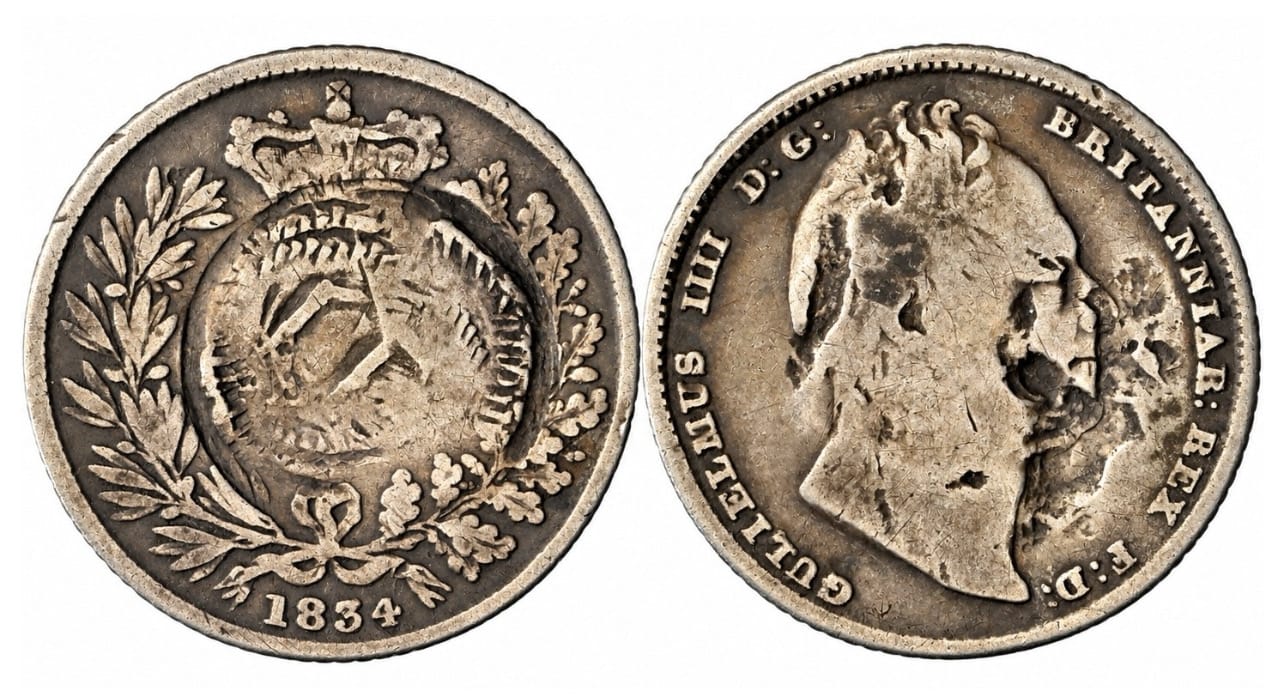
A newly published study of a deformed British coin from 1834 raises a question larger than numismatics: how can artificial intelligence help research without becoming a substitute for evidence?
The paper, published in npj Heritage Science, examined a William IV sixpence. The dispute was never about whether the coin looked unusual. It was about where the deformation came from: did it happen while the coin was being struck, or later, through damage, compression or wear? The study concludes that the physical measurements make a severe mint-stage striking anomaly the explanation most consistent with the evidence, while keeping a later constrained-compression event as a possibility that cannot be excluded absolutely.
That careful wording matters. This is not a story about “AI solving a mystery”, nor about “a lab proving a ready-made theory”. It is an example of a research process that started with several hypotheses, put them to independent measurement, and arrived at a conclusion bounded by what the evidence allows.
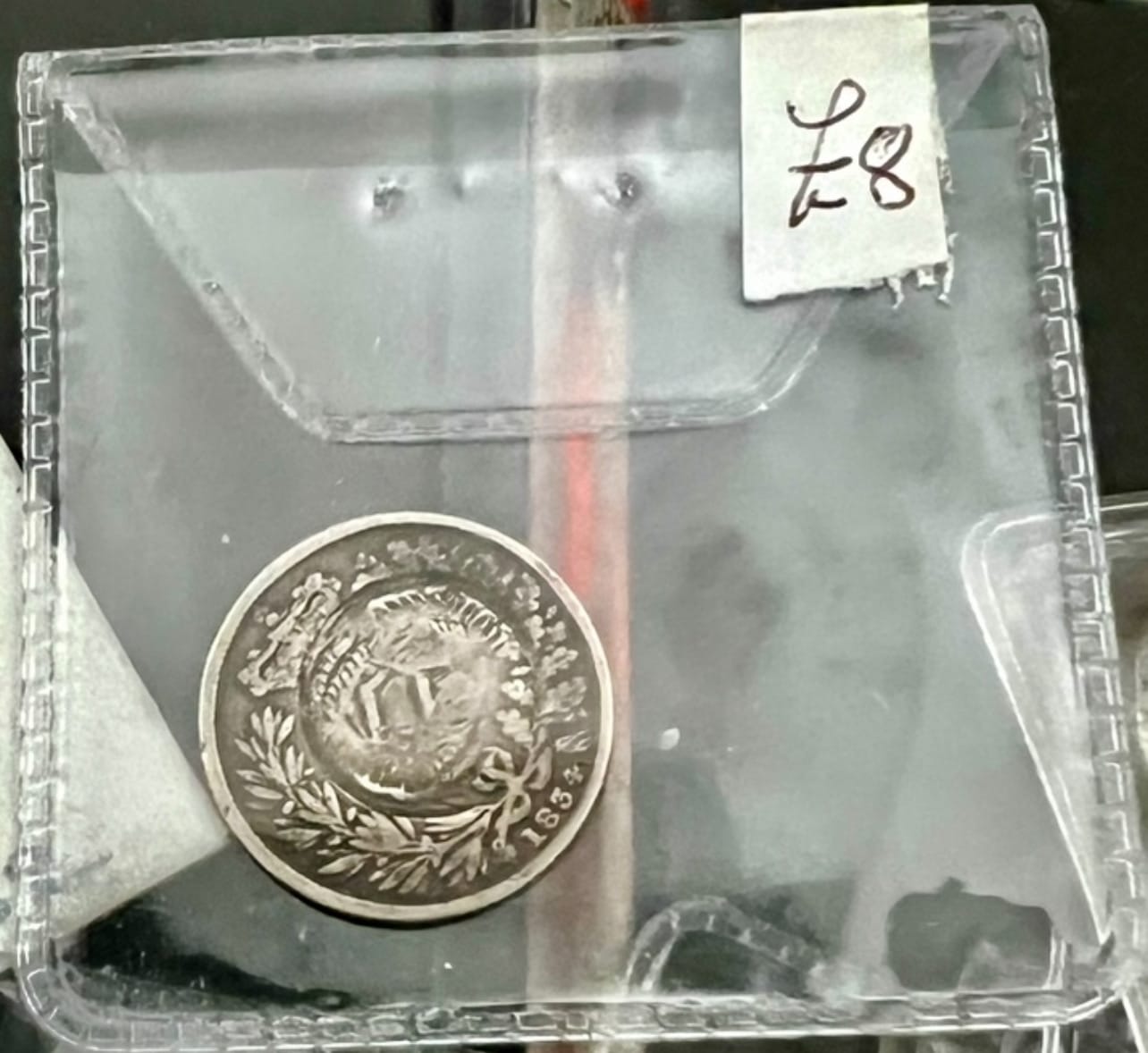
The coin was found in a mixed coin album bought as a job lot at a car-boot sale in Greater Manchester. The handwritten “£8” on its sleeve is neither its price nor its value today, because the coin was never bought on its own. It is held in a private collection whose owner is not being disclosed, and there is currently no public sale process. For documentation purposes, the project obtained an independent insurance valuation in March 2026 from a UK Chartered Arts and Antiques Surveyor; the amount remains private.
The project relied on SEM-EDX analysis at the Experimental Techniques Centre, Brunel University London, and on optical surface profilometry at the Oxford Materials Characterisation Service, University of Oxford. These were independently commissioned analytical services, and neither their staff nor their institutions were co-authors of the study. What the results mean for the coin's history is the author's interpretation alone, and it does not represent institutional endorsement of his conclusion.
From observation to a testable question
A. Ikraam, an independent researcher in the United Kingdom and founder of IA STUDIO, an independent heritage science research initiative, says visual assessment alone was not resolving the competing explanations. Preliminary external assessments based on images generally favoured post-mint damage, and a specialist who later examined the coin in hand, before laboratory testing, did not accept the mint-stage interpretation. Ikraam, for his part, saw features he thought justified testing alternatives, so rather than treating either view as decisive, he wanted evidence from the specimen itself.
Instead of accepting any early opinion as the final answer, the project separated three layers: what could be observed, what could be hypothesised, and what needed testing. Imaging and anomaly mapping became questions about composition, surface geometry, deformation relationships and mechanical plausibility.
This is where AI shows up in its most disciplined form: organising observations, comparing hypotheses, spotting inconsistencies and helping frame sharper questions. It did not examine the coin, it did not produce the laboratory measurements, and it did not decide the scientific conclusion.
An exclusive interview with A. Ikraam
AI Gossips is pleased to publish this exclusive interview with A. Ikraam, who shared with us the path of the project from the first observation to laboratory measurement, and the limits he set on the role of AI along the way.
What made scientific investigation necessary?
For Ikraam, the core problem was that visual assessment could not settle the competing explanations. The investigation therefore moved from detailed imaging and documentation of visible features to independently commissioned, non-destructive measurements. The purpose, he says, was not to use laboratory work to confirm a preferred answer, but to see how far the coin's measurable properties could narrow the competing explanations.
Which hypotheses were on the table before testing?
The broad alternatives were deformation during minting and deformation later in the coin's history, including impact, compression, wear, corrosion or combinations of these. He says the key step was to separate observation, hypothesis and test: what can actually be seen, and what kind of physical evidence might distinguish one explanation from another?
Where did AI help, and where did its role stop?
Ikraam says AI tools were most useful for organising observations, comparing explanations and challenging his own assumptions, but their output was never treated as evidence. He used commercially available large language model and multimodal tools, together with a research-oriented AI assistant for literature and comparative support. That work began before the laboratory measurements were available, and contemporaneous records predating the tests document it; after the results came in, the same tools helped organise and compare them and supported manuscript preparation. The tools did not generate the SEM-EDX measurements or the profilometry, and they did not decide the final interpretation. Scientific judgement remained the author's, constrained by the specimen's own data.
How did the independent measurements change the early hypotheses?
The results narrowed the investigation substantially, but they did not simply confirm an earlier diagnosis developed with AI support. Before testing, the exploratory work included a broader and more mechanically specific range of reconstructions, which had to be reconsidered against the measured properties. Taken together, the data favour a severe mint-stage striking anomaly over ordinary wear, corrosion or a single unconstrained later impact. But they do not justify reconstructing every mechanical step with certainty, which is why the paper keeps its scientific qualification.
What does meaningful human supervision mean?
For Ikraam, supervision starts before an AI system gives an answer: deciding which questions are worth asking, separating observation from inference, checking sources and spotting assumptions that need independent testing. Above all, it means being prepared to reject an attractive explanation if the evidence does not support it. In his words, the aim is “a process in which AI can be wrong, challenged and corrected while still remaining useful.”
What has AI changed in research?
Speed and structure have changed, along with the ability to organise material and compare lines of enquiry. What has not changed is the need for proper physical examination, reliable measurements, verifiable sources and plain language about uncertainty. He stresses that hypotheses developed with AI support must stay provisional and open to correction.
What separates analytical services, interpretation and institutional endorsement?
The distinction is clear: the laboratories produced independent physical measurements, the researcher interprets what they mean, and the involvement of the Brunel and Oxford facilities should not be read as institutional endorsement of the final conclusion. Likewise, the physical measurements should not be attributed to AI simply because it was used to organise the thinking.
From one case to a framework
Project 001 became the founding case of IA STUDIO's Hybrid Reasoning Framework, formalised as Edition 1.1 in January 2026, with a fixed archival record deposited on Zenodo in October 2026. Ikraam says the framework was formalised after the investigation had begun, so he does not claim that Edition 1.1 governed every earlier stage, and that it is procedural and model agnostic, not tied to any particular AI system. The framework distinguishes four roles: laboratory measurement, documentary evidence, computational interpretive support and final human interpretation. The record itself acknowledges that the framework has not yet undergone separate peer-reviewed methodological validation across multiple cases, and that more granular implementation details are being kept for further research.
Ikraam says an earlier account of the project was published on the British Numismatic Society Research Blog in 2025, after the laboratory work was complete, and that the peer-reviewed paper published in September 2026 is now the current scientific account: it retains the core mint-stage interpretation while refining the reconstruction of the deformation mechanism.
The wider lesson
The lesson reaches beyond a single coin. As AI moves into applied research, the value of a method lies in whether it can be traced and held to account: what was observed? What was assumed? What was measured independently? And who is responsible for the interpretation?
That is the heart of hybrid reasoning as this project presents it: AI can be useful for thinking, but it should never be dressed up as evidence.
Editor's note: both photographs were supplied by A. Ikraam / IA STUDIO and are published with his permission for this coverage; copyright remains with him.